
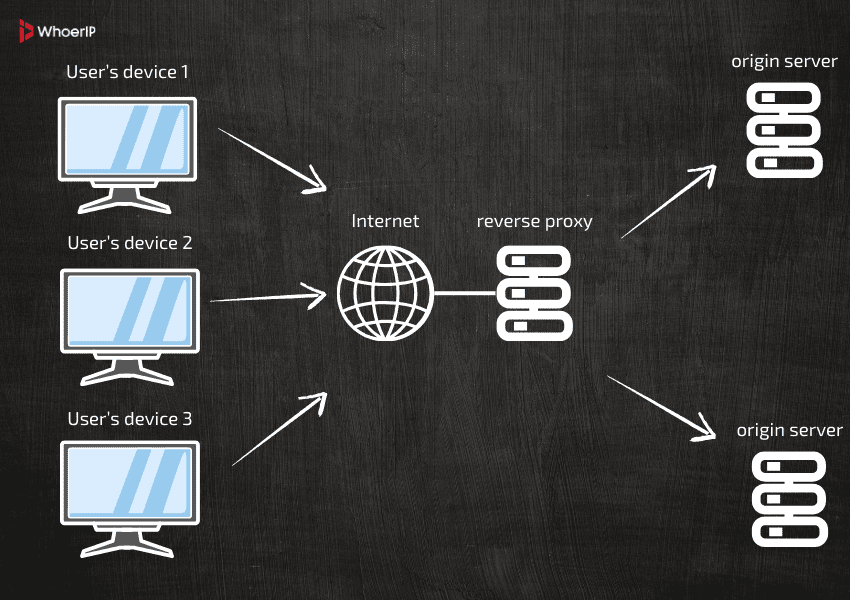
A reverse proxy is a server that stands between users and the backend systems that run a website or application. Instead of browsers connecting directly to an origin server, they send their requests to the proxy first.
The proxy then decides where the request should go, retrieves the response from the appropriate backend machine, and passes it back to the user as if it came straight from the proxy itself.
This extra layer adds protection, improves performance, and helps websites handle large volumes of traffic without falling over.
Some historical information
Reverse proxy servers emerged in the mid‑to‑late 1990s as an evolution of earlier forward proxies that ISPs and enterprises used mostly for caching and bandwidth optimization. As dynamic sites and e‑commerce grew, engineers started placing specialized proxy servers in front of web servers to offload caching, SSL/TLS termination, and basic load distribution, which effectively defined the “reverse proxy” pattern.
FYI: A single reverse proxy can hide and load-balance traffic across 100+ backend servers, while exposing only 1 public IP address.
In the 2000s these components evolved into full application delivery controllers and load balancers, adding health checks, URL‑based routing, and more advanced traffic management. At the same time, they became an important security layer, hiding origin IPs, filtering malicious requests, and later integrating web application firewalls.
With the rise of CDNs and cloud platforms, globally distributed edge nodes began acting as massive reverse proxy networks, and today reverse proxies are tightly integrated with microservices and APIs as smart gateways for routing, authentication, and rate limiting.
How a Reverse Proxy Works
Although the internal logic can get complex, the basic workflow usually follows five main steps:
- Request Interception: A browser sends a request to a website, and the reverse proxy receives it before any backend server does.
- Routing Decision: The proxy chooses which backend server should handle the request. This choice might depend on server load, request type, or even the user’s geography.
- Forwarding: The chosen backend server receives the request from the proxy.
- Response Processing: The backend server generates a response and returns it to the proxy.
- Delivery to the Client: Before passing the response back to the user, the proxy may cache it, compress it, or apply security rules to optimize both speed and safety.
Key Features and Benefits
1. Security
- IP Masking:
By hiding the backend servers’ real IP addresses, the proxy makes it harder for attackers to target them directly. - Traffic Filtering:
Malicious requests—including common web attacks—can be blocked at the proxy before they reach sensitive systems. - SSL/TLS Termination:
The proxy can handle encryption and decryption, reducing the workload on backend servers and centralizing certificate management.
2. Performance
- Caching:
Frequently accessed content can be stored at the proxy, reducing response time and easing pressure on backend servers. - Compression:
Optimizing data before sending it to the client saves bandwidth and speeds up loading. - Load Balancing:
Incoming traffic is distributed across multiple servers, preventing overload and increasing availability.
3. Scalability
- Simplified Growth:
New backend servers can be added behind the proxy without changing anything for end users. - Geo-Targeted Routing:
Users can be directed to the nearest data center, a technique used by CDNs to reduce latency.
Reverse Proxy vs. Forward Proxy
| Feature | Reverse Proxy | Forward Proxy |
|---|---|---|
| Primary Role | Protects servers, optimizes responses | Protects clients, controls outbound requests |
| Location | Between clients and servers | Between clients and the wider internet |
| Common Uses | Caching, security, load balancing | Privacy, content filtering |
| Examples | NGINX, Apache, Cloudflare | Squid, Privoxy |
Real-World Use Cases
- Content Delivery Networks (CDNs):
Providers such as Cloudflare and Akamai rely heavily on reverse proxy mechanics to serve cached content quickly to users around the world. - API Protection:
Reverse proxies help shield APIs from abuse, rate-limit requests, and guard against DDoS attacks. - Microservices Routing:
In architectures used by companies like Netflix or Spotify, reverse proxies route traffic to the correct microservice. - Server-Side Analytics:
Some analytics and tag-management tools use reverse proxies to improve data security and reliability.
Why Reverse Proxies Matter
Reverse proxies are no longer just intermediaries—they are essential to modern web infrastructure. They protect servers from attacks, boost performance, and enable seamless scalability, all while remaining invisible to end users.
As cloud computing, CDNs, and microservices continue to evolve, their importance will only grow. Reverse proxies aren’t just tools; they are the backbone of fast, secure, and reliable digital experiences.