

Understanding Metered Billing
Building usage-based pricing into your product shouldn’t require building a second startup. Yet many companies find themselves overwhelmed by the engineering complexity of accurately tracking consumption, calculating charges across diverse pricing tiers, and generating invoices that customers trust. Metered billing platforms exist precisely to solve this problem — providing production-ready infrastructure that handles the entire consumption-to-invoice lifecycle.
These systems serve as the operational backbone for consumption-based business models. They capture usage signals as they occur, apply aggregation rules that transform raw events into billable units, execute rating logic that determines charges based on your pricing strategy, and automate invoice generation with complete transparency. Whether you’re tracking milliseconds of compute time, gigabytes of bandwidth, API requests, or proprietary metrics unique to your product, the right platform ensures billing accuracy while freeing your team to focus on product development.
The metered billing landscape spans from open-source platforms offering maximum control to enterprise solutions providing white-glove implementation support. Some platforms excel at technical flexibility through SQL or JavaScript configuration, while others prioritize ease of use with visual interfaces. This diversity means there’s likely a platform well-suited to your specific needs — but it also means the selection process requires careful evaluation of your requirements, constraints, and growth trajectory.
Top Metered Billing Systems Compared
| Software Name | Key Focus | Target Audience |
|---|---|---|
| UniBee | Real-time usage metering | SaaS, AI, and Fintech |
| Maxio | Financial operations and metrics | B2B SaaS Enterprises |
| Chargebee | Subscription management suite | Scaling SaaS Businesses |
| Lago | Open-source API-first metering | Developer-centric Teams |
| Recurly | Payment and churn optimization | B2C and B2B Subscriptions |
| Togai | High-scale usage infrastructure | High-volume Data Platforms |
1. UniBee
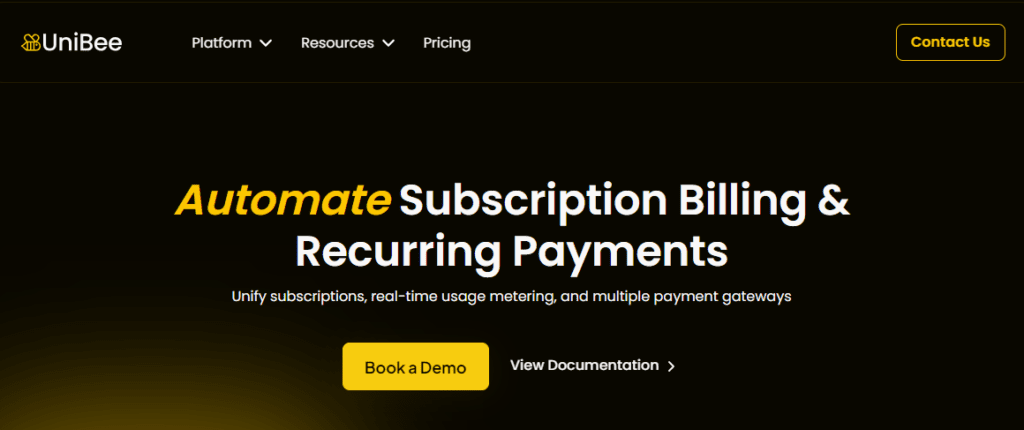
UniBee stands as a purpose-built, open-source platform engineered specifically for usage-based billing from inception. Unlike legacy systems retrofitted for consumption tracking, UniBee was designed to handle the complexities of metering, rating, and invoicing inherent in consumption-based business models. The platform emphasizes developer experience, pricing flexibility, and enterprise scalability without typical enterprise solution overhead.
Key Capabilities
- Multi-Dimensional Metering: Track unlimited usage metrics—API calls, data storage, compute hours, transactions, or custom events
- Real-Time Rating Engine: Instantaneous processing of usage events with immediate cost visibility
- Sophisticated Pricing Models: Multi-tiered structures, volume discounts, hybrid models, commitment contracts with overage management
- Deployment Flexibility: Self-hosted or cloud options provide control over data and infrastructure
- Comprehensive APIs: Enable rapid deployment and integration with existing systems
| Pros | Cons |
|---|---|
| ✅Swift implementation through well-documented APIs | ❌Building market presence versus established competitors |
| ✅Complete pricing model freedom and customization | ❌Requires technical expertise for self-hosted deployments |
| ✅Real-time usage visibility with full transparency | ❌Optimized for efficiency rather than complex organizational structures |
| ✅Enterprise-scale capabilities at accessible pricing | ❌Primary focus on usage-based and subscription billing |
| ✅Active development with responsive open-source community |
2. Maxio
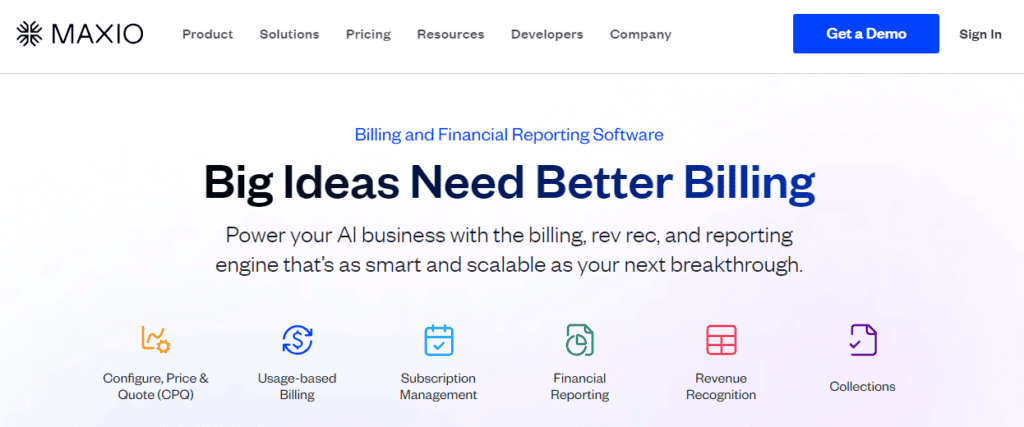
Maxio combines subscription billing with comprehensive financial operations capabilities, born from merging SaaSOptics and Chargify. The platform serves B2B SaaS companies needing integrated solutions for invoicing, revenue recognition, and financial reporting. Maxio accommodates both subscription and usage-based pricing models — including hybrid approaches— while maintaining compliance with accounting standards including ASC 606.
Key Capabilities
- Revenue Recognition Automation: ASC 606 compliant with built-in accounting workflows.
- SaaS Metrics Dashboard: Purpose-built analytics for B2B SaaS financial KPIs.
- Hybrid Model Support: Combines recurring subscriptions with usage components.
- Financial Reporting: Deep integration with accounting systems and ERPs.
- Dunning Management: Advanced payment recovery and retention tools.
| Pros | Cons |
|---|---|
| ✅Strong financial operations focus with built-in revenue recognition | ❌Usage-based billing is secondary to subscription focus |
| ✅Comprehensive SaaS metrics and analytics | ❌Higher price point relative to specialized tools |
| ✅Well-suited for B2B subscription-primary businesses | ❌Advanced features can be complex to configure |
| ✅Mature platform with established integrations | ❌May feel overly enterprise-oriented for early-stage startups |
| ✅Good balance of billing and finance features | ❌Less flexible than pure usage-based platforms |
3. Chargebee
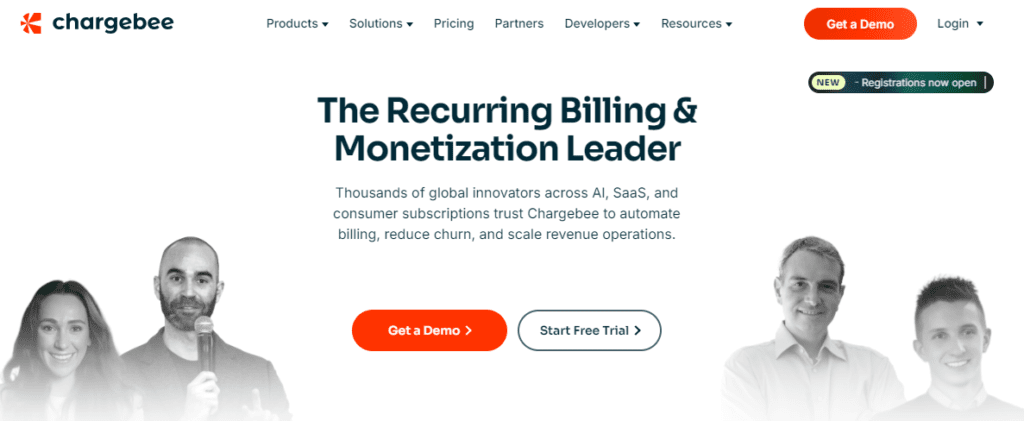
Chargebee represents a mature, enterprise-proven subscription and revenue management platform that has evolved to encompass sophisticated usage-based billing capabilities. The platform connects usage data to quoting, contracting, and billing in one unified system, addressing the operational complexity that arises when sales must quote usage, product teams must gate features, and finance must bill accurately. Chargebee positions itself as infrastructure purpose-built for companies transitioning to or scaling usage-based monetization.
Key Capabilities
- Flexible Metering Engine: Visual filters for simple rules, SQL for advanced logic, supporting any aggregation method (sum, count, min, max, average)
- CPQ Integration: Configure-price-quote functionality allowing sales to quote complex usage models on customer calls
- Hybrid Model Support: Seamlessly combines recurring subscriptions with usage components, included units, overages, and credits
- Revenue Recognition: Automated ASC 606-compliant revenue recognition with flexible MRR/ARR calculations
| Pros | Cons |
|---|---|
| ✅Mature platform with extensive integration ecosystem (payment gateways, accounting systems, CRMs) | ❌Higher price point relative to specialized usage-only platforms |
| ✅Strong CPQ capabilities enable sales teams to quote usage without engineering bottlenecks | ❌Can feel complex for simple, pure usage-based models |
| ✅Comprehensive hybrid billing support (subscription + usage + one-time charges) | ❌Requires configuration investment to leverage full capabilities |
| ✅Built-in controls for enterprise exceptions and custom pricing | ❌May be overkill for early-stage startups with straightforward needs |
| ❌Learning curve for administrators managing complex pricing rule |
4. Lago
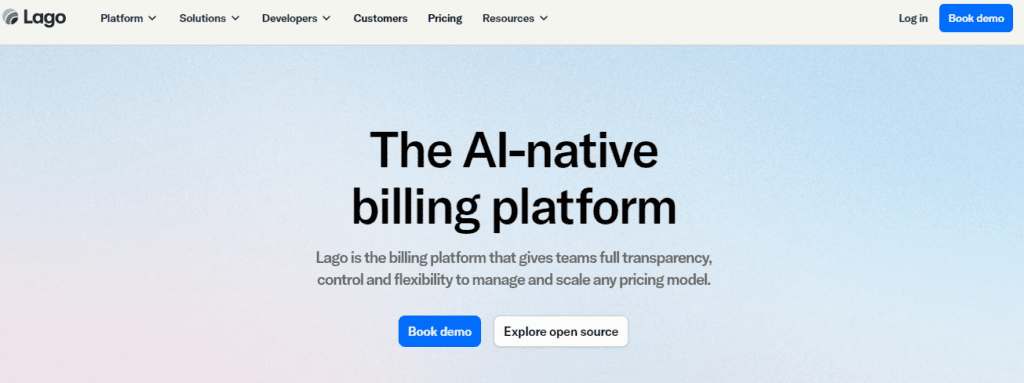
Lago is an open-source billing platform that gives teams full transparency, control, and flexibility to manage and scale any pricing model. The platform helps engineering and business teams collaborate on complex billing through both APIs and a visual interface. Lago positions itself as combining the best of third-party vendors and homegrown systems, eliminating the “black box” problem common in proprietary solutions.
Key Capabilities
- Open-Source Transparency: Full codebase visibility and customization potential
- Unified Platform: Subscriptions, usage-based pricing, and hybrid models in one system
- Real-Time Event Processing: Handles high-volume usage streams efficiently
- Visual Interface + APIs: Serves both technical and non-technical users
- Multi-Product Support: Consolidate billing across different products and geographies
| Pros | Cons |
|---|---|
| ✅Complete transparency—no black box billing | ❌Self-hosting requires infrastructure management expertise |
| ✅Active open-source community and continuous development | ❌Smaller enterprise feature set compared to commercial platforms |
| ✅Flexibility to customize without vendor restrictions | ❌Community support may be slower than dedicated support teams |
| ✅Strong adoption by notable companies (Mistral AI, PayPal) | ❌Requires more technical setup than turnkey solutions |
| ✅Can deploy self-hosted or cloud-based | ❌Some advanced features may need custom development |
| ✅Developer-friendly with comprehensive APIs |
5. Recurly
Recurly brings over a decade of subscription management expertise, having expanded its platform to incorporate usage-based billing alongside core recurring revenue functionality. The platform delivers mature, enterprise-proven infrastructure built for reliability and scale. Recurly prioritizes subscriber retention through intelligent payment recovery workflows, flexible billing options, and revenue optimization features designed to reduce involuntary churn.
Key Capabilities
- Advanced Dunning: Intelligent payment recovery workflows minimize involuntary churn
- Hybrid Billing: Supports subscription base with variable usage components
- Global Payment Support: Broad payment gateway and international payment method coverage
- Revenue Optimization: Tools designed to maximize recurring revenue retention
- Mature Platform: Battle-tested infrastructure with proven reliability
| Pros | Cons |
|---|---|
| ✅Proven platform with over a decade of experience | ❌Usage-based functionality lags specialized competitors |
| ✅Sophisticated payment recovery and retention capabilities | ❌Pricing can escalate significantly at scale |
| ✅Extensive payment gateway and global support | ❌User interface feels dated compared to modern alternatives |
| ✅Well-optimized for hybrid subscription-usage models | ❌Best for subscription-primary, not usage-native businesses |
| ✅Enterprise-grade reliability and scale | ❌Limited advanced metering capabilities |
6. Togai
Togai provides scalable billing infrastructure specifically tailored for usage-based pricing models. The platform distinguishes itself through its powerful rule engine that allows creation of custom billing rules using JavaScript, enabling businesses to handle complex pricing scenarios that other platforms struggle with. Togai emphasizes rapid implementation—cutting launch times from months to days.
Key Capabilities
- JavaScript Rule Engine: Create custom billing rules beyond standard configurations
- Data Processing Excellence: Transform raw data (character counts to SMS, API calls to billable units) with precision
- Pricing Flexibility: Support for 100+ different monetization strategies in a single system
- Real-Time Metering: Immediate usage tracking and aggregation capabilities
- Geographic Pricing: Configure different pricing based on customer location with automated calculations
| Pros | Cons |
|---|---|
| ✅Exceptional pricing rule customization via JavaScript | ❌Requires technical understanding for optimal rule configuration |
| ✅Rapid deployment timeline (days instead of months) | ❌Can become complex for simple use cases |
| ✅Strong data transformation capabilities for complex billing scenarios | ❌Learning curve for maximizing rule engine capabilities |
| ✅Comprehensive alert system (usage limits, entitlements, credit balances) | ❌May be overkill for straightforward billing needs |
| ✅Multiple integration options (30+ out-of-box integrations) | |
| ✅Free tier available for testing and experimentation |
Choosing the Right Metered Billing System
Early-Stage Startups
- Best Choices: UniBee, Lago, Togai
- Rationale: Cost efficiency, flexibility, rapid implementation
Growth-Stage Companies
- Best Choices: UniBee, Chargebee
- Rationale: Balance scalability with enterprise features, support pricing experimentation
Enterprise Organizations
- Best Choices: UniBee, Maxio
- Rationale: Enterprise-grade compliance, scale, and comprehensive feature sets
Conclusoin
Ultimately, the best choice depends on your specific needs: the complexity of your pricing model, your technical resources, and your long-term growth trajectory. Whether you prioritize developer control, financial operations, or rapid deployment, there is a metered billing platform designed to meet your requirements—allowing you to focus on delivering value to your customers, rather than building billing infrastructure from scratch. As the market continues to evolve, the key is to select a solution that not only addresses your current challenges but also adapts to the future demands of your business.
Frequently Asked Questions
Which is the best software for billing?
The best billing software depends on your business needs. For general invoicing and subscription management, Chargebee and Recurly are highly regarded for their flexibility and integration capabilities. For usage-based or metered billing, UniBee and Lago are strong choices, especially for developer-centric teams. Enterprises with complex financial operations often prefer Maxio for its comprehensive revenue recognition and SaaS metrics.
What is the most popular medical billing software?
As of 2026, AdvancedMD, Kareo, and DrChrono are among the most popular medical billing software solutions. These platforms are widely used for their ability to handle claims processing, patient billing, and compliance with healthcare regulations like HIPAA. Epic Systems and Cerner are also prominent in larger healthcare organizations.
What is metered software?
Metered software refers to applications or services that track usage—such as time spent, features accessed, or resources consumed—and bill customers based on actual consumption rather than a flat fee. This model is common in cloud services, APIs, and SaaS platforms, allowing users to pay only for what they use.
What is the best invoicing software?
The best invoicing software varies by use case. QuickBooks Online is a top choice for small businesses due to its ease of use and accounting integration. FreshBooks is popular among freelancers and service providers for its intuitive interface and time-tracking features. For larger businesses, Zoho Invoice and Xero offer robust automation and scalability.
What is metered billing?
Metered billing is a pricing model where customers are charged based on their actual usage of a product or service. This can include metrics like API calls, data storage, compute time, or other measurable activities. Metered billing is transparent and flexible, making it ideal for businesses with variable or unpredictable usage patterns.
What is a metered service?
A metered service is any service that tracks and bills customers according to their usage. Examples include cloud computing (where you pay for CPU hours or storage), utilities (like electricity or water), and digital services (such as API calls or data transfers). Metered services provide granular billing and often include tools for monitoring and managing consumption.
What is a metered API?
A metered API is an application programming interface that charges users based on the number of requests or the volume of data processed. This model allows developers to access API functionality without upfront costs, paying only for the calls they make. Metered APIs are common in cloud platforms, data services, and developer tools.
What are the top 3 cloud services?
As of 2026, the top three cloud services by market share and adoption are Amazon Web Services (AWS), Microsoft Azure, and Google Cloud Platform (GCP). These platforms offer a wide range of services, including computing power, storage, databases, and AI tools, catering to businesses of all sizes.
What is SaaS?
SaaS, or Software as a Service, is a software distribution model where applications are hosted by a service provider and made available to customers over the internet. Users typically access SaaS products via a web browser, paying a subscription fee rather than purchasing and installing software locally. SaaS is known for its scalability, automatic updates, and ease of access.