TL;DR: To change your IP address to another country, you need to route your internet traffic through a server located in that country. A VPN is the most reliable and beginner-friendly way to do it. Proxies and Tor also work, but each comes with trade-offs around speed, security, and ease of use.

Your IP address reveals exactly where you are. Every website you visit, every service you use, sees it. A country, a city, sometimes a street-level location. That single number is the main thing standing between you and content that is blocked in your region.
Changing your IP to a foreign address means borrowing a different identity online. Not in a deceptive sense, more like putting on a different coat before stepping outside.
Three methods actually work for most people: a VPN, a proxy server, and the Tor browser. Each works differently and fits a different kind of user.
How Does Changing Your IP to Another Country Actually Work?
Changing your IP address to another country works by redirecting your internet traffic through a server located in that country, making websites think you are there.
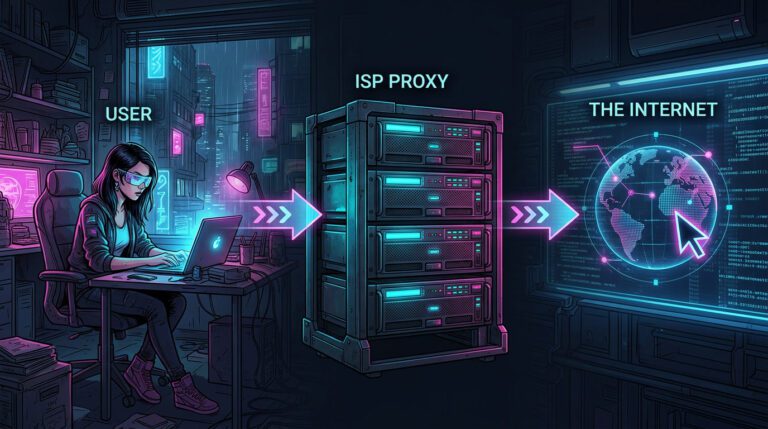
Your IP address is assigned by your ISP (internet service provider). Normally, every request you make goes: your device, your ISP, the destination website. The website sees your real IP, handed over by your ISP. To change what that website sees, you need to insert a middle layer. A server in, say, Germany or Canada that forwards your traffic and hands over its own IP instead of yours. The destination website has no idea who is actually behind it.
FYI: Before you test any method, always check your current IP and location first. Use Whoerip.com to see exactly what information websites can read about your connection, including your real country, DNS leaks, and WebRTC exposure.
Method 1: VPN (The Most Reliable Way)
A VPN is the fastest and most complete answer to the question of how to change your IP address to another country.
A VPN (Virtual Private Network) creates an encrypted tunnel between your device and a server in another country. All your traffic flows through that tunnel. Websites see the VPN server’s IP, not yours. The encryption also means your ISP cannot read what you are doing, which is a meaningful difference compared to proxies.
Steps to change your IP using a VPN:
- Choose a VPN service that has servers in the country you need
- Download and install the app on your device (Windows, macOS, Android, iOS)
- Open the app, log in, and select the country you want to appear from
- Click connect and wait a few seconds
- Visit Whoerip.com to confirm your IP has changed and no leaks are visible
Pro Tip: After connecting to a VPN, always run a leak check at Whoerip.com. Some VPN configurations leak your real DNS or WebRTC data even when the main IP looks correct. If whoerip.com shows your actual country in the DNS section, your VPN has a leak and is not fully protecting you.
The main advantage of a VPN is that it covers all traffic from your device at once. Not just the browser, the whole system. That matters when you want to use streaming apps, games, or desktop software that would otherwise be geo-blocked.
Method 2: Proxy Servers
A proxy server also routes your traffic through a remote server, but without encryption and usually for browser traffic only.
Think of a proxy as a basic forwarding service. You tell your browser to use a proxy address, and your requests go through it. Websites see the proxy’s IP. Simple. The catch is that proxies do not encrypt your data, so your ISP can still see what you are doing. Free proxies are often slow, unreliable, and sometimes actively monitored by the people running them.
Still, proxies are useful for lightweight tasks: checking how a website looks from a specific country, quick testing, or situations where you do not need privacy, just a different location.
When proxies make sense:
- Quick geographic checks without installing anything
- Browser-level location switching for testing
- Situations where speed and encryption are not the priority
FYI: Paid proxy services (residential proxies, in particular) are significantly more reliable than free ones. Free proxies change frequently, often go offline without notice, and some have been known to inject ads or track your activity.
Method 3: Tor Browser
Tor routes your traffic through at least three volunteer-operated nodes before it reaches its destination, making it very hard to trace back to you.
Originally developed for privacy activists and journalists, Tor is genuinely powerful. Each node in the chain only knows the address of the previous and next node, not the full path. By the time your traffic exits onto the internet, it carries the IP of the exit node, which could be in any country at all. You have no control over which exit node you get, so you cannot reliably choose a specific country the way you can with a VPN.
The trade-off is speed. Tor is noticeably slower than a VPN, sometimes dramatically so. For watching video or anything latency-sensitive, it is frustrating to use. For research, reading, and basic browsing where anonymity matters more than speed, it works well.
Method 4: Mobile Data and Airplane Mode
Toggling airplane mode or switching from Wi-Fi to mobile data can give you a new IP address, but almost always within your home country.
This is worth knowing because it is often listed as a method, and technically it is true that your IP changes. Your mobile carrier assigns a new IP from their pool each time you reconnect. But that pool belongs to your carrier, which is in your country. So while your IP changes, your apparent location does not move abroad. Useful for getting a new local IP, not for appearing to be in another country.
Comparison: VPN vs Proxy vs Tor
| Feature | VPN | Proxy | Tor |
|---|---|---|---|
| Hides your IP | Yes | Yes | Yes |
| Encrypts traffic | Yes | No | Yes |
| Choose specific country | Yes | Yes | Limited |
| Speed | Fast | Moderate | Slow |
| Covers all apps | Yes | Browser only | Browser only |
| Setup difficulty | Easy | Very easy | Easy |
| Best for | General use | Quick checks | High anonymity |
How to Verify Your IP Has Changed
After switching to any method, verifying the result is not optional, it is the whole point.
Go to Whoerip.com and run a full check. The tool shows your visible IP address, the country it belongs to, whether your DNS is leaking a different location, whether WebRTC is exposing your real IP, and whether your connection is flagged as a VPN or proxy. That last part matters if you are trying to access a service that blocks known VPN addresses. If the IP is showing the right country but the service still blocks you, whoerip.com will likely show why.
Pro Tip: Some websites and streaming platforms check not just your IP but also your browser’s timezone, language settings, and even fonts. If those do not match the country your IP suggests, you may still get blocked. Whoerip.com’s fingerprint check will highlight these mismatches.
Also worth checking: your browser’s cached cookies. A website you have visited before may have stored your real location in a cookie. Clearing your cache and cookies before testing your new IP gives a cleaner result.
What Can Block You Even with a Foreign IP?
Getting a foreign IP is step one. A few things can still give you away.
WebRTC leaks are the most common problem. Your browser can expose your real local IP through WebRTC even when a VPN is active. Whoerip.com tests for this directly. DNS leaks are the second issue: if your DNS queries go through your regular ISP’s servers instead of the VPN’s, your real location shows up in the DNS section of the check.
Beyond technical leaks, some platforms maintain blacklists of known VPN and proxy IP ranges. If you are connecting through a popular service, there is a reasonable chance the IP you get is already on one of those lists. Again, the reputation check on whoerip.com will flag this.
Related reading: How to Find Your IP Address on Windows, Mac, and iPhone, How to Hide Your IP Address, How to Change Your IP Address, What Is a DNS Leak and How to Prevent It.
Frequently Asked Questions
Is changing your IP address to another country illegal?
In most countries, changing your IP address is completely legal. Using a VPN or proxy to appear from a different location is not a criminal act in the vast majority of jurisdictions. The activity you do with that IP is a separate matter. Using a foreign IP to commit fraud, bypass sanctions, or access systems without authorization is illegal, but that is about the action, not the IP change itself. A few countries with heavy internet restrictions (China, Russia, Iran, for example) have regulations around the use of VPNs, so it is worth checking local rules if you are in one of those places.
Does a VPN change your IP address?
Yes, a VPN replaces your visible IP address with the IP of the VPN server you connect to. Websites and online services see the server's IP, not yours. The change is immediate once the connection is established, and you can verify it using an IP lookup tool.
Can the FBI track a VPN?
With legal authority and cooperation from a VPN provider, yes, in some cases. If a VPN service keeps connection logs and receives a valid legal request, those logs can potentially link an IP to an account. Services that maintain a genuine no-logs policy and are based outside US jurisdiction are harder to trace, but no method is completely immune to a determined investigation with full legal backing.
Can I change my IP address to another country without a VPN?
Yes. Proxy servers and the Tor browser both allow you to route traffic through a foreign IP without using a VPN. Proxies are simpler to set up but offer no encryption. Tor provides strong anonymity but slower speeds. Neither is as straightforward or as complete in coverage as a VPN for regular use.
Is 192.168.1.1 a real IP address?
It is a real IP address, but not a public one. The 192.168.x.x range is reserved for private local networks, the kind that exists inside your home router. Your router uses 192.168.1.1 as its local gateway address. This IP is never visible to the public internet. When someone asks what your IP is, they mean your public IP, which is the one assigned by your ISP and visible to outside servers.
Can my IP be tracked if I am using a VPN?
Your public IP visible to websites changes to the VPN server's address, so direct tracking by IP becomes harder. However, you can still be tracked through browser fingerprinting, cookies, logged-in accounts, and WebRTC or DNS leaks if the VPN is not configured properly. A full check at Whoerip.com will show whether your setup has any of these leaks active.